
A Demand for Reality
The Second Sunday of Easter (Year A)

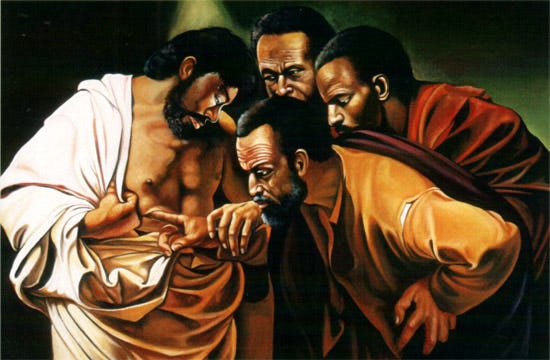
“By Faith, Not By Sight,” Alix Beaujour
Scripture
Acts 2:14a, 22-32; Psalm 16; 1 Peter 1:3-9; John 20:19-31
___
Prayer
Blessed are you, O God of our Lord Jesus Christ, in whom we receive the legacy of a living hope, born again not only from his death but also from his resurrection. May we who have received forgiveness of sins through the Holy Spirit live to set others free, until, at length, we enter the inheritance that is imperishable and unfading, where Christ lives and reigns with you and the same Spirit. Amen. (Revised Common Lectionary)
___
Reflection
The room is closed tight, behind closed doors holding fear. The disciples have gathered in the shadow of crucifixion, trying to make sense of a world that has come apart. Then Jesus appears among them, not knocking, not waiting, simply present. Peace is the first word spoken. Wounds are shown, not hidden. Hands and side become testimony. Joy rises, though it is the kind that still trembles.
Thomas is not there for any of it. When the others tell the story, it sounds almost too complete, too neat. Resurrection, peace, mission, Spirit. Everything resolved in a single encounter. Yet Thomas stands outside that moment, holding only the words of others. Refusal comes quickly, but it is not shallow stubbornness. It is something more daring. Thomas names what everyone else must have felt but did not say aloud. Unless the wounds are seen and touched, belief will not come. It is a demand for reality, not illusion. A protest against easy answers.
A week later, the same room holds the same group, this time with Thomas present. The doors are still shut. Fear has not vanished just because hope has entered. Again Jesus appears, and again peace is spoken. Then attention turns directly to Thomas. The invitation is almost disarming in its openness. Touch the wounds. See for yourself. Bring doubt into the light instead of hiding it behind polite agreement. There is no rebuke in the tone, only an invitation to step fully into truth.
Thomas responds with one of the clearest confessions in the whole story. “My Lord and my God.” The one who demanded proof now offers recognition. Doubt, it turns out, was not the opposite of faith but a path into its center. By daring to speak the questions no one else voiced, Thomas makes space for a fuller encounter. The others believed through sight. Thomas believed through confrontation with both absence and presence, with both longing and fulfillment.
Jesus speaks one more word that stretches beyond the room. Blessed are those who have not seen and yet believe. This is not a dismissal of Thomas but an expansion of the story. Future followers will not have the same physical evidence. Faith will grow in a different kind of soil. Yet Thomas remains essential because the questions remain essential. Faith that never wrestles can become thin, easily shaken by the first real challenge. Faith that has passed through honest doubt carries a different kind of depth.
The scene closes with a reminder that many other signs were not written down, but these have been recorded so that belief might take root. Life, in this telling, comes through trust in the one who still bears wounds. Thomas stands as a witness to the courage it takes to ask for truth when easy belief is available. That courage becomes a gift to everyone who comes later, still wondering, still hoping, still daring to ask.
PRAYER: Almighty and everlasting God, who in the Paschal mystery established the new covenant of reconciliation: Grant that all who have been reborn into the fellowship of Christ’s Body may show forth in their lives what they profess by their faith; through Jesus Christ our Lord, who lives and reigns with you and the Holy Spirit, one God, for ever and ever. Amen. (Book of Common Prayer)
___
"Doubting Thomas" Tells Us All We Need To Know About Christianity:
https://www.debunking-christianity.com/2025/08/what-could-convince-reasonable-people.html