
Divine Restraint
Reflecting on the Sixth Sunday of Easter: One Day after Sunday: (Year A)

Scripture
Psalm 93; Genesis 9:8-17; Acts 27:39-44
___
Prayer
O God, who for our redemption gave your only-begotten Son to the death of the cross, and by his glorious resurrection delivered us from the power of our enemy: Grant us so to die daily to sin, that we may evermore live with him in the joy of his resurrection; through Jesus Christ your Son our Lord, who lives and reigns with you and the Holy Spirit, one God, now and for ever. Amen. (Book of Common Prayer)
___
Reflection
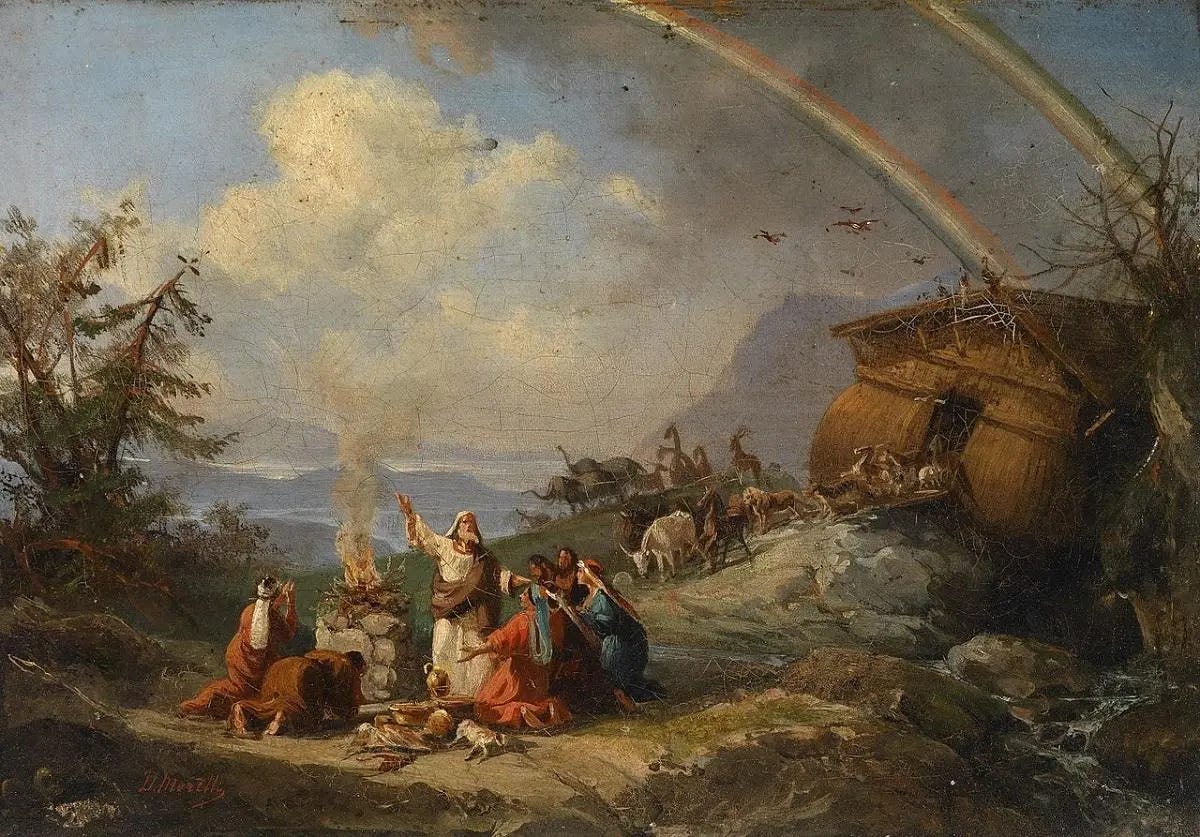
In Genesis 9:8–17, the narrative takes a more measured tone following the tumult of the flood, presenting itself as a promise. God speaks not only to Noah but also to his sons and notably to “every living creature.” The preceding flood account is traumatic—human violence has reached its peak, and creation seems to descend once again into chaotic waters, echoing the initial verses of Genesis. However, in this covenant moment, God draws a definitive line (or perhaps more aptly, marks it in the sky). There will no longer be floodwaters that annihilate all life.
As part of this promise, God establishes the rainbow in the clouds, not as a decoration but a reminder. This reminder serves God’s own recollection of the covenant. This represents a theological shift. In ancient traditions, covenants included symbols to remind people of their obligations. Yet here, God transcends this norm and binds himself to creation. The rainbow symbolizes a form of divine self-restraint. Despite human failures—and we are aware that more failures are forthcoming—God vows to safeguard the world.
Within Genesis 1–11, this passage acts as a stabilizing force. The first eleven chapters illustrate a downward spiral of human actions starting with Adam and Eve’s disobedience, progressing through Cain’s violence, leading to widespread corruption culminating in the flood, and finally resulting in humanity’s prideful ambition with the tower at Babel. It narrates repeated ruptures in both divine-human relationships and among humans themselves.
Our passage does not ignore this reality; rather, it reframes it. God explicitly acknowledges that human sin persists, yet total destruction is far from being an effective solution. Prior to the flood, God’s judgment resulted in wiping everything clean; post-flood, God opts for patience over obliteration. While consequences for human actions remain later in Scripture’s narrative, it signifies a shift in God’s overall attitude towards the world.
The covenant established with Noah is universal. It extends beyond just one chosen family or nation, encompassing all living beings. This paves the way for subsequent events in Genesis and further on. When God calls Abraham in Genesis 12 with promises to bless “all families of the earth,” it builds upon this earlier commitment to creation as a whole. The rainbow serves as a theological proclamation regarding our understanding of God portrayed in these early narratives: one who judges but also exercises restraint for humanity’s sake.
In what could easily be perceived as a bleak segment of Scripture, Genesis 9:8–17 introduces an authentic glimmer of hope. It emphasizes that despite ongoing struggles and failures among humans, creation’s stability relies not on human virtue but rather on divine faithfulness.
PRAYER: Mighty God, in whom we know the power of redemption, you stand among us in the shadows of our time. As we move through every sorrow and trial of this life, uphold us with knowledge of the final morning when, in the glorious presence of your risen Son, we will share in his resurrection, redeemed and restored to the fullness of life and forever freed to be your people. Amen. (Revised Common Lectionary)
___